The functionnotation for the rule "square, add 8, then take the square root" is expressed as [tex] f (x) = \sqrt {x^2 + 8} [/tex]. This represents the operations step-by-step based on their order.
In functionnotation, we first identify the operations we have to perform on the input variable. Here, we first add 3 to the variable and then multiply the result by 2.
Functionnotation is a precise and simplified way to express the relationship between inputs and outputs. Instead of using the typical y = format, functionnotation replaces y with a function name, such as f (x), where f represents the function's name, and x is the input variable.
Functionnotation is a way to represent and work with functions in mathematics. It provides a clear and concise way to express the relationship between inputs (independent variables) and outputs (dependent variables).
In this guide, we'll break down how to expresstheruleinfunctionnotation, step-by-step, making it super easy to understand. Think of it like learning a new dialect of math – let's get started!
To represent “height is a function of age,” we start by identifying the descriptive variables h for height and a for age. The letters f, g, and h are often used to represent functions just as we use x, y, and z to represent numbers and A, B, and C to represent sets.
To express the rule "Subtract 9, square, then subtract 1" in functionnotation, we start with the variable representing our input, which is typically denoted as x.
In the context of functionnotation, these expressions allow us to translate word-based rules into a concise mathematical form. For instance, consider the rule "Add 1, take the square root, then divide by 6."
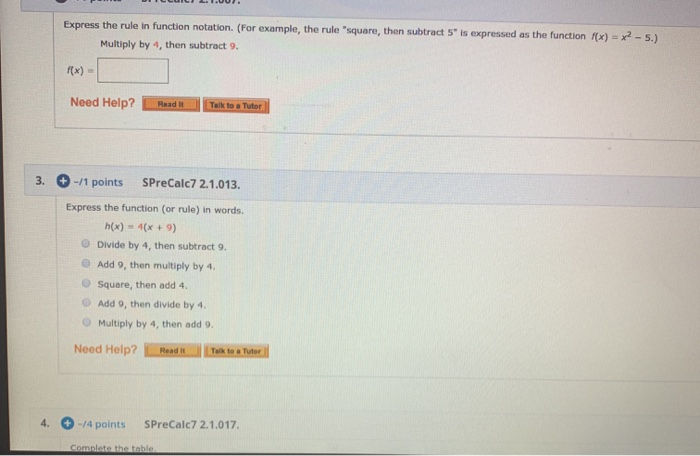 Here’s how to approach this question To express the rule "Multiply by 4, then subtract 9" in function notation, let f (x) = 4 x 9.